 English

How to Compare Game Key Marketplaces
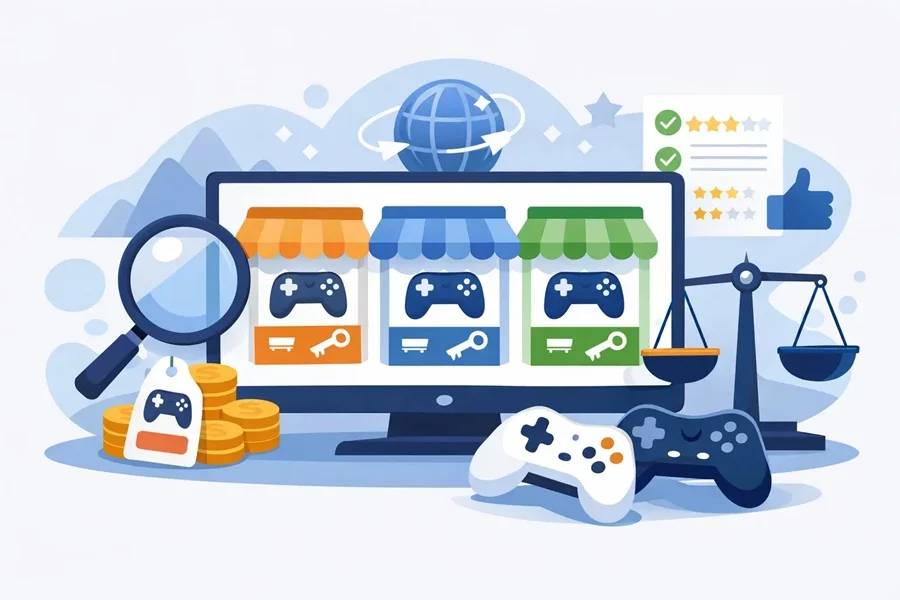
You found the same game for three different prices, and the cheapest one is not always the best deal. That is the real starting point for how to compare game key marketplaces. A low sticker price can hide bad seller standards, slow delivery, region issues, weak support, or extra checkout fees that make the "deal" less attractive once you actually pay.
If you buy digital codes often, you need a fast way to judge value and risk at the same time. Good marketplaces make that easy. Weak ones make you do all the detective work yourself. The goal is not just finding the lowest number on the page. It is finding the best overall buy for your platform, your region, and your tolerance for risk.
How to compare game key marketplaces without wasting money
The fastest way to compare marketplaces is to treat each one like a full package, not a price tag. Look at the final cost, the product details, the delivery promise, the seller screening, and what happens if something goes wrong. If one site is $2 cheaper but gives vague region info and slow support, that is not automatically the better option.
Start with the exact product. Make sure you are comparing the same edition, the same platform, and the same type of delivery. A standard edition Steam key is not the same as a Deluxe Edition key, an account-based product, or a region-limited activation code. A lot of bad comparisons happen because buyers rush past those details and only look at the price.
After that, check whether the marketplace clearly explains what you are buying. Good product pages usually state the platform, edition, region, activation method, delivery format, and any restrictions. If that information is buried, incomplete, or written in a way that feels intentionally vague, move on.
Price matters, but final price matters more
This is where plenty of buyers get tripped up. A marketplace can look cheapest in search results and still end up more expensive at checkout. Service fees, payment processing fees, taxes, currency conversion, and optional buyer protection can change the final total fast.
The smartest comparison is the checkout comparison. Put the same item in the cart on two or three marketplaces and see what the actual payable amount looks like before you commit. If one site starts low but stacks extra charges late in the process, that tells you something about how it does business.
Also pay attention to pricing patterns. If a marketplace is constantly far below every competitor on major new releases, that does not automatically mean it is bad, but it does mean you should inspect the listing more carefully. The best deals usually still look believable within the broader market.
Seller quality is a huge part of the deal
Some marketplaces sell directly. Others act as platforms for third-party sellers. That does not make third-party marketplaces bad, but it does mean seller quality matters a lot. You are not only judging the site. You are judging how well the site vets sellers and handles disputes.
Look for signs that the marketplace takes seller standards seriously. Verified seller labels, visible sales history, review volume, dispute tracking, and clear penalties for bad behavior all help. A seller with a long track record and strong recent feedback is usually a safer bet than a brand-new account with a suspiciously perfect score from very few buyers.
Recent feedback matters more than lifetime averages. A seller may have built a decent reputation years ago and slipped badly since then. Read the latest comments, especially complaints about revoked keys, incorrect regions, delayed delivery, or support refusing to help.
Product clarity separates good sites from frustrating ones
A solid marketplace should answer the questions buyers ask before they need to ask them. Is the key global, region-free, or region-locked? Is it for Steam, Epic Games, Xbox, PlayStation, Nintendo, EA App, Rockstar, Battle.net, GOG, or Microsoft Store? Is the code delivered instantly, manually, or after review? Is it a key, a gift, or another digital format?
When you compare marketplaces, pay attention to how clearly they present this info. A cheap code becomes expensive if it does not activate in your country or on your platform. For deal-seekers buying across PC and console ecosystems, this is one of the easiest ways to avoid wasted money.
It also helps to check whether the listing explains activation steps. That matters even more for DLC, subscriptions, gift cards, and software licenses, where compatibility can be stricter than buyers expect.
Delivery speed is part of the value
Instant delivery has real value, especially if you are buying right before a launch weekend, a game night, or a limited-time event. Some marketplaces are built around automated delivery, while others rely more heavily on seller response time or manual review.
If speed matters to you, do not assume every digital product is truly instant. Look for realistic wording. "Instant delivery" should mean automated fulfillment within minutes in normal cases, not "we usually send it sometime today." Good marketplaces make that clear before checkout.
The same goes for stock reliability. A site can list a product at a great price and then delay fulfillment because the key is not actually ready. Marketplaces that manage inventory and delivery expectations well are usually worth a slight premium.
Support is what you notice only when something breaks
Support quality is easy to ignore until you need it. Then it becomes the whole experience. This is a major part of how to compare game key marketplaces like a smart buyer instead of a lucky one.
Check how the marketplace handles problems such as invalid codes, duplicate keys, payment issues, or region mismatches. The good signs are simple: clear refund or replacement rules, visible support channels, reasonable response times, and a process that does not make the buyer prove the impossible.
You are looking for practical support, not fancy wording. If the site has a polished FAQ but buyers keep saying support is slow or dismissive, trust the pattern. Fast delivery and cheap pricing lose a lot of value if the marketplace disappears when an order goes wrong.
Safety signals to look for before you buy
A trustworthy marketplace usually gives off the right signals early. Secure checkout is the baseline, but there is more to check than that. You want transparent policies, clear business information, realistic product descriptions, and consistent communication throughout the buying process.
Be cautious with marketplaces that overpromise, hide terms, or make basic information hard to find. If a site does not clearly explain refunds, seller accountability, or what happens with failed delivery, that is a risk signal. Cheap is good. Cheap plus unclear is where problems start.
Payment options matter too. Reputable platforms tend to support payment methods buyers already trust. That does not guarantee a perfect experience, but it does show the marketplace is built for mainstream digital commerce rather than quick one-off transactions.
Compare selection based on what you actually buy
Not every buyer needs the same marketplace. If you mainly buy Steam games, a site with deep PC inventory and better filters may be more useful than one with broad but messy coverage. If you buy across Xbox, PlayStation, Nintendo, software licenses, gift cards, and subscriptions, selection breadth starts to matter more.
A larger catalog is only valuable if the browsing experience is good. Strong search, useful filters, platform sorting, edition visibility, and stock accuracy all save time. For regular deal hunters, that convenience adds up. A marketplace like Playnox, for example, makes more sense when you want one place to compare gaming codes, gift cards, software, and platform-specific offers without bouncing between multiple sites.
The best marketplace depends on the purchase
There is no single best option for every order. For a cheap older PC game, the lowest final price from a well-rated seller may be enough. For a brand-new release, expensive collector-tier edition, or software license you need right away, support quality and delivery reliability may matter more than saving a couple of dollars.
That is why blanket advice rarely helps. The right comparison is situational. Ask what matters most for this purchase: lowest cost, fastest delivery, safest seller history, broadest payment options, or strongest support if something fails.
A good rule is simple. If a marketplace is competitive on price, clear on product details, consistent on delivery, and credible on support, it is worth keeping in your rotation. If it wins on only one of those and looks shaky everywhere else, keep looking.
The best deal is the one you do not have to fix after checkout, and that is usually where smart buyers save the most money over time.